
A conversation the learner has out loud, with an AI character who pushes back.
The learner practices a hard conversation by video before having it for real. The AI character plays the other side, and does not accept a vague answer.
- How
- Out loud, by video
- Setting
- A safe place to practice
- Feedback
- Quotes the learner's own words
- Where it runs
- Any LTI-compliant LMS
Practice that talks back.
Role-play in front of colleagues is awkward, and a branching video with three canned replies only teaches the replies. Here the learner says what they would really say, and the other side answers it.
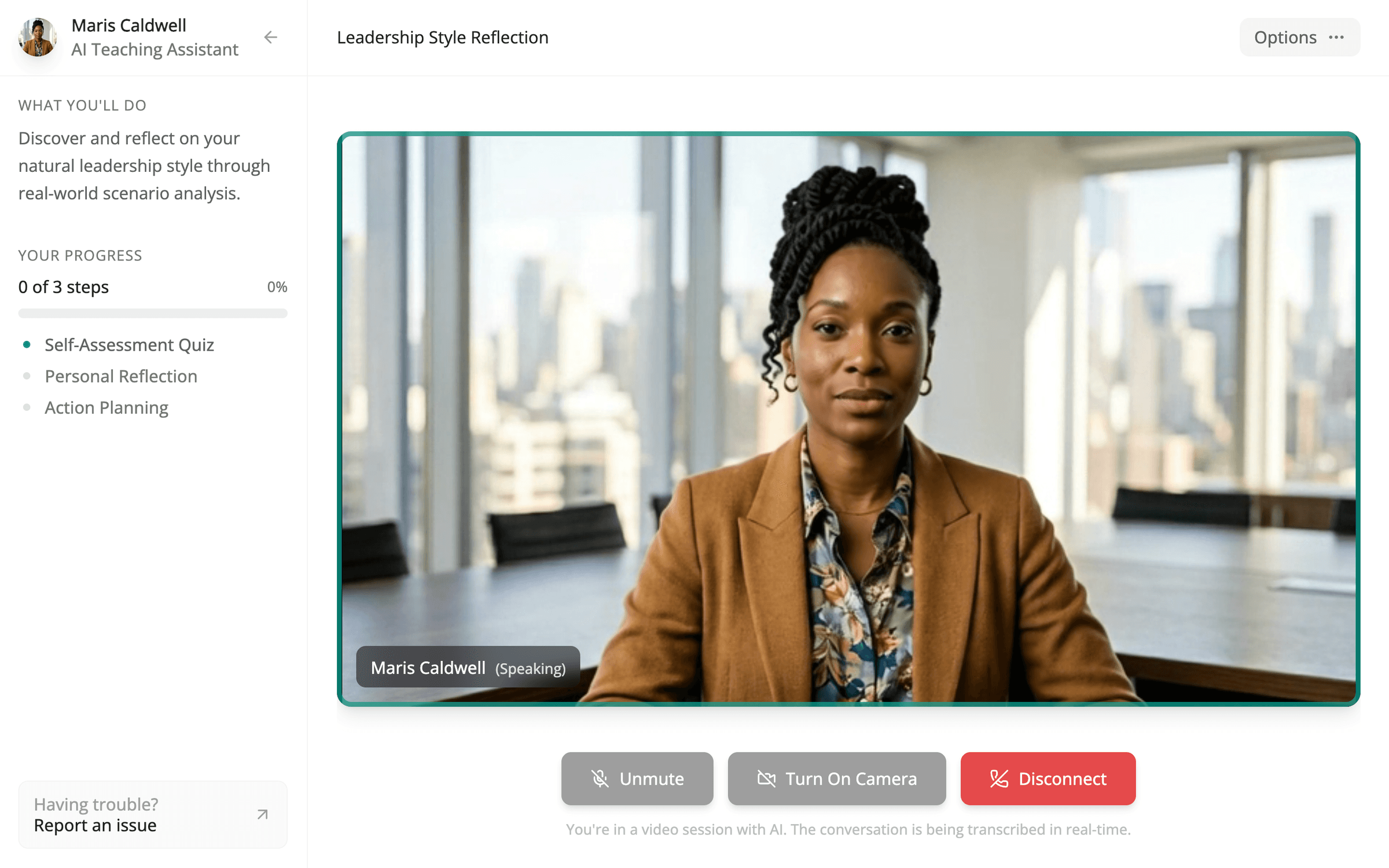
The learner says it out loud
They speak through their own microphone and camera, and can interrupt, as in a real conversation. Saying it is harder than picking a reply from a list, and it is what the real conversation will ask of them.
The character pushes back
It has a name, a role and a position of its own, and it is labeled as AI. A vague answer gets “That sounds operationally strong, but it’s still fuzzy.” A request meets an objection, such as a tight budget.
Feedback quotes their words
The conversation is transcribed as it happens. Feedback quotes what the learner actually said, says which techniques they used, and names what is missing, so they know what to change on the next try.
It is a safe place to practice, and the criteria are yours.
A safe place to practice
Most conversations are one learner with an AI character, and some scenes put several learners in with the AI characters. The instructor can always see the conversation. The point is a place to try, get it wrong, and try again before it counts.
Several characters at one table
In a multi-character conference, several AI characters sit at one table, each with a position of their own, and the learner has to hold a line.
What your instructor or your expert sets
Feedback is written against criteria they wrote or approved, and the learner can read those criteria before starting. Where the conversation counts, it can be AI-graded and human-confirmed, fully by people, or fully by AI.
Practice can come before or after the teaching.
It can show where people start, force a decision on a case, or be the rehearsal before the real thing. Three examples, with the conversation in a different place each time.
To see where people start
- Practice conversation
- Interactive lecture
- AI coaching
- A second conversation
A first try, cold, shows what the learner already does. The lecture teaches what was missing, coaching goes back over it, and a second conversation shows what changed.
To test a decision
- Case study
- Practice conversation
- Discussion
- Reflection
The case sets out the situation and the conversation forces a decision. A discussion compares how others handled it, and the learner writes what they would change.
To get ready for the real thing
- Interactive lecture
- Dramatized case
- Practice conversation
- Scored simulation
The lecture teaches the technique and the dramatized case shows it used. The learner then tries it in practice before a scored simulation that counts.
More ways to build the skill.
Scored simulations
When the result of the conversation is scored and recorded.
See scored simulationsDramatized cases
A scene to watch before the learner has the conversation themselves.
See dramatized casesAI tutors & coaches
Coaching after the conversation, where the AI coach answers a question with a harder one.
See AI tutorsTell us which conversation is hardest to practice.
Book a demo and bring the situation. We build an example from your own material, at no cost, before you decide.