
You decide what is taught.
We build the course.
Alma’s learning engineers build complete interactive courses, and whole programs course by course, from the material your university or company already has.
- A new course
- Live in weeks
- Your team's time
- About a day of decisions
- Where it runs
- Any LTI-compliant LMS
- Ownership
- You own what is built
Great content is not the same as great learning.
You already have the material. Making a course from it is a separate job, and with each of the usual routes your own people still end up doing the work.
Record the lectures
Your instructors record, and re-record each time something changes.
License a content library
Written for someone else, so your people adapt it course by course.
Build in-house or brief an agency
The drafting and the chasing land on the experts you can least spare.
Give the production to Alma
Our learning engineers build the course from your material. Your people review it and approve it.
One course, or every course in a program.
Choose the side that describes you.
For educational institutions
Credit-bearing courses and programs, built with your faculty
Alma's learning engineers take the production. Your faculty and learning designers keep the direction and the approval, and every activity is traced to the learning outcomes approved for the course. Lectures show your faculty, in their own face and voice, with their written agreement. You pay a fee for the work, with no share of tuition.
For corporate learning
Training programs built from your playbook and reviewed by your experts
We start from your calls, your floor, and your cases. Your people rehearse real conversations with a counterpart who pushes back, and get feedback on what they said and did. Alma's learning engineers build the program, your experts review it, and it is updated in days when the playbook changes.
Your students or your people spend most of every hour doing.
They practice a conversation out loud, or revise a draft and hand it in again. From here down, "student" means whoever takes the course, at a university or a company.
The AI character pushes back on anything vague.
Feedback quotes the student’s own words and names what is missing. Written work comes back with comments, and the student revises and resubmits it.
Activity types
Interactive lecture
Every video lecture has an AI teaching assistant. Students raise a hand and ask, or get cold-called.
Multi-character conference
Several AI characters at one table, each with a position of their own. The student has to hold a line.
Text and audio chat
Written or spoken practice with an AI tutor, and coaching by voice. The AI mentor coach answers a question with a harder one.
Discussion
Every post gets a considered reply, from the course's AI teaching assistant and from classmates.
Animated scene
The student watches a dramatized case and names each technique as it is used.
Knowledge check
It can play as a game, and it still works as an ordinary graded quiz in your LMS.
There are more than a dozen activity types, and we keep adding new ones.
The same activity types, in a different order, teach a different thing.
A chatbot in the corner is not teaching. In an Alma course, every activity sits in a sequence chosen for what the student should be able to do at the end.
01
Conceptual understanding
When the goal is to understand
The lecture teaches the framework, the reading anchors it, and the knowledge check shows what stuck. The student then restates it in their own words.
02
Skill practice
When the goal is to do
The case sets the situation and the simulation forces a decision. Coaching goes back over the reasoning, and a second scenario tests whether it holds.
03
Applied judgment
When the goal is to decide
A scene raises the dilemma. Discussion tests each position against classmates, and the simulation makes the student commit to one. The reflection names the principle behind the choice.
Three examples of what gets built.
Each one illustrates what the product does. None describes a client.
One course
A three-credit university course
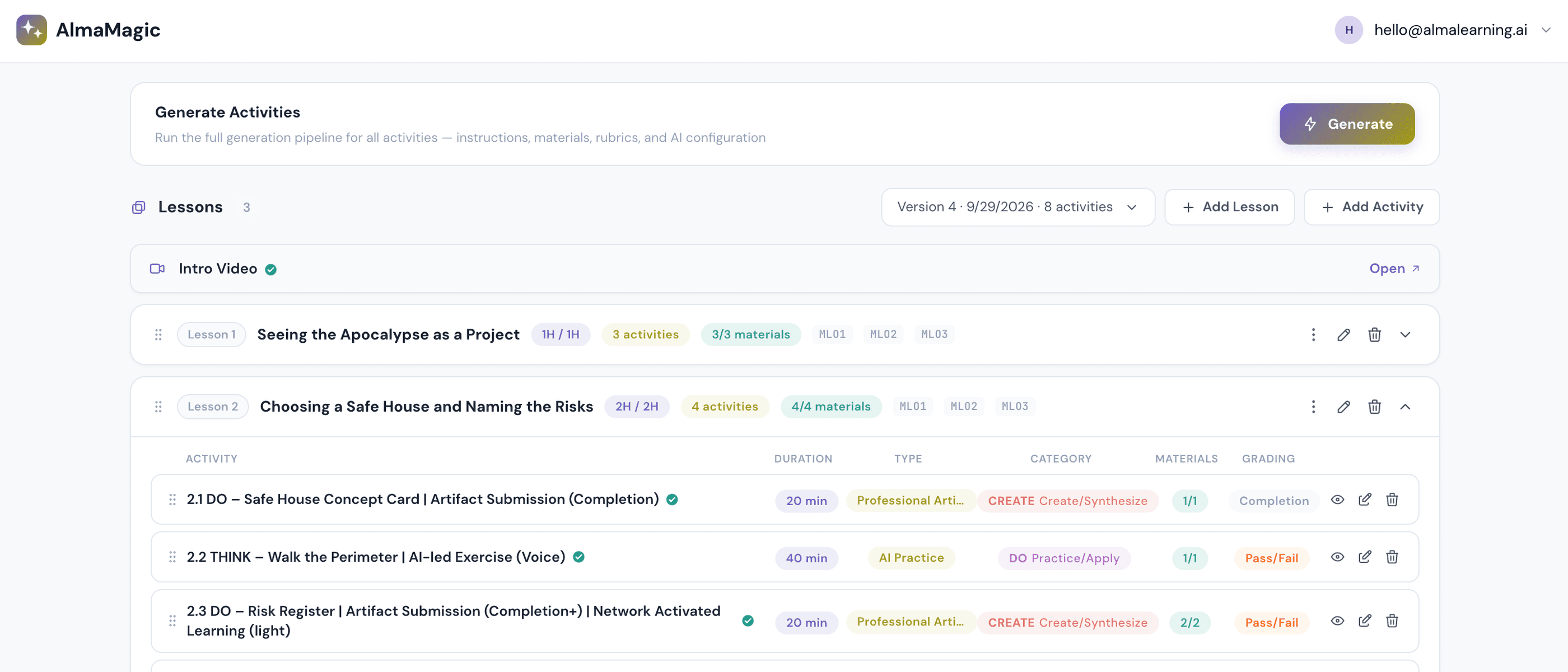
Built from a syllabus and slides. It holds 8 modules and about 200 activities, and each activity carries a learning objective, a time estimate, and a written design rationale.
See what is in the course
One program
A program for first-time managers
It starts from a conversation managers avoid. Each manager rehearses it out loud with an AI counterpart, hears feedback that quotes their own words, and is checked against the standard your experts set.
See the program
One workshop
A negotiation workshop for account managers
Before the session, each person covers the basics and negotiates by voice with an AI counterpart playing the buyer. Your facilitator stays the teacher.
See the workshop
Your architects draw. Our learning engineers lay the bricks.
Your people keep the direction and the review: what to teach, how, and whether it is right. Alma’s learning engineers do the production and follow your drawings to the letter.
We write rubrics and quiz banks to your standard. Every slide, video, and handout follows your style guide, and your team can check the course against your own accessibility guidance before launch. When your templates change, the change goes through every course the same way.
The student never sees Alma. The course runs under your name in any LTI-compliant LMS, or in Alma’s own. Your material stays on Alma’s platform and is never used to train a model.
Every design choice comes to you as a short menu with our recommendation.
01
What fills the hours
Your syllabus sets the hours. You choose which activity types fill them.
02
The sequence
What students do first, where the path branches, and which activities are required or elective.
03
Which roles stay human
You decide role by role, office hours included. The AI teaching assistant supports your instructors' teaching and does not replace their interaction with students. A course can run fully online, blended with your timetable, or around teaching you already do.
04
How work is graded
AI-graded and human-confirmed, fully by your people, or fully by AI where you choose. Grading follows your rubrics, or ones we draft and you approve.
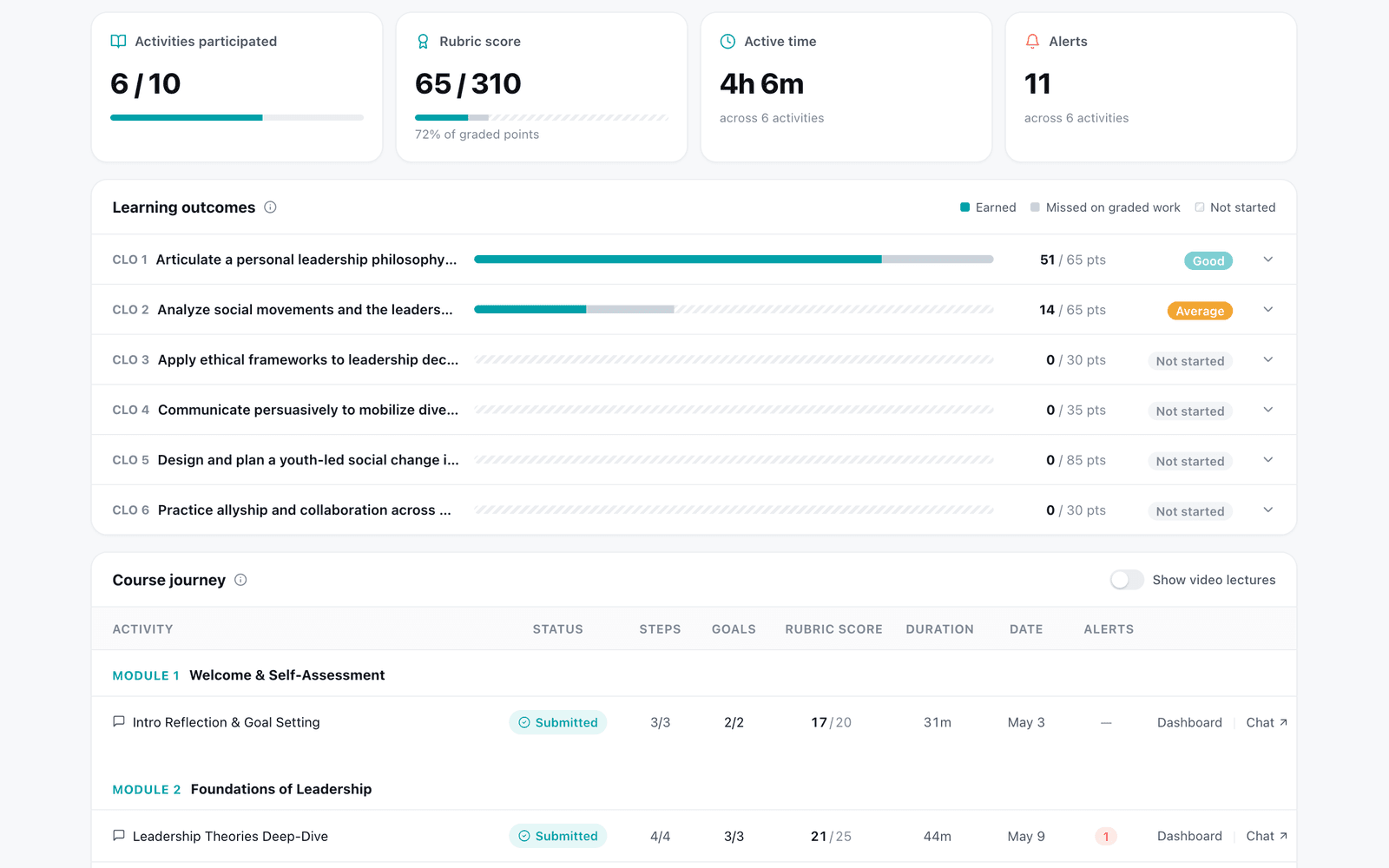
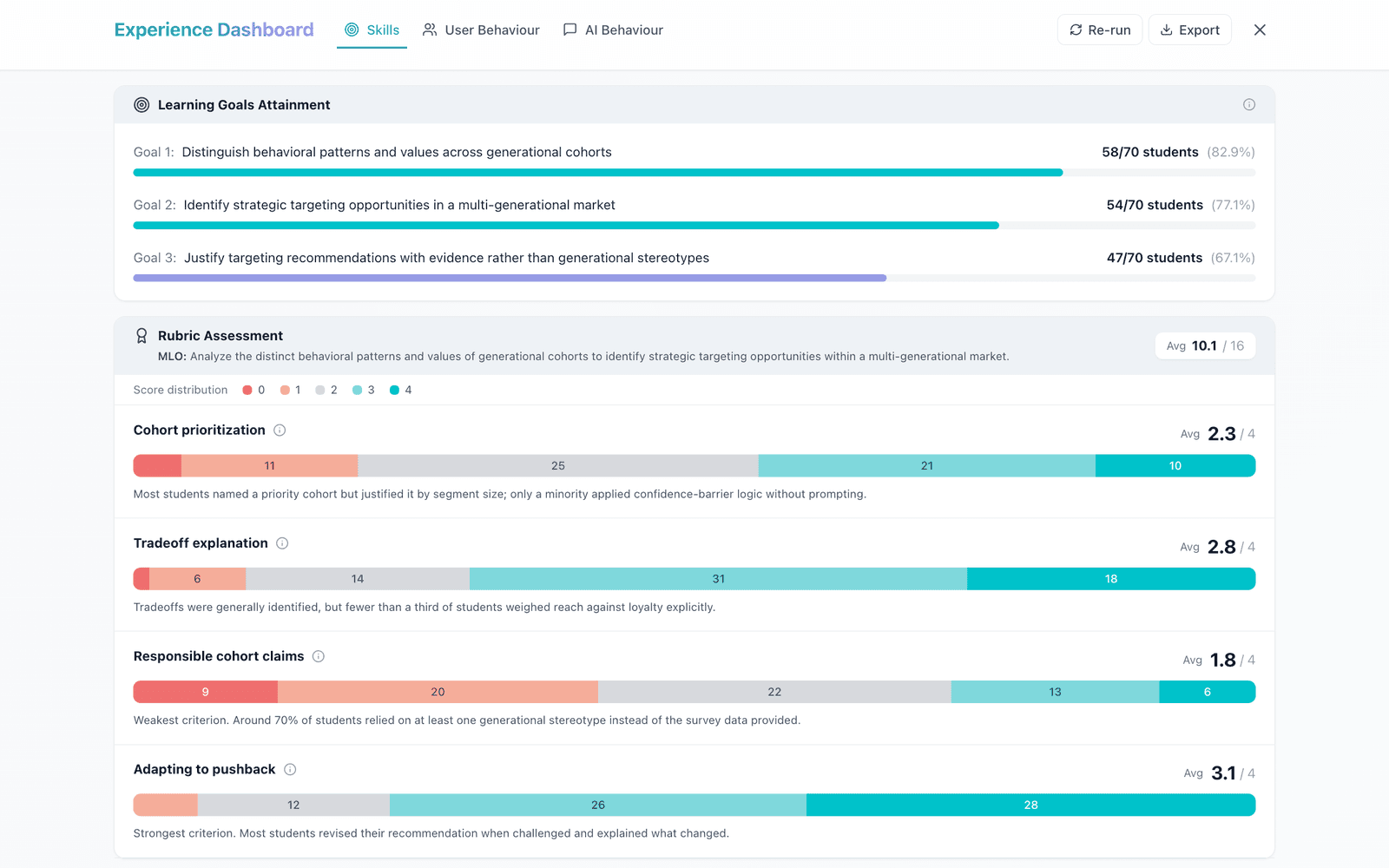
You see who is at risk while there is still time to help.
Program managers see the whole cohort at once, and instructors can open any one student's progress and step in.
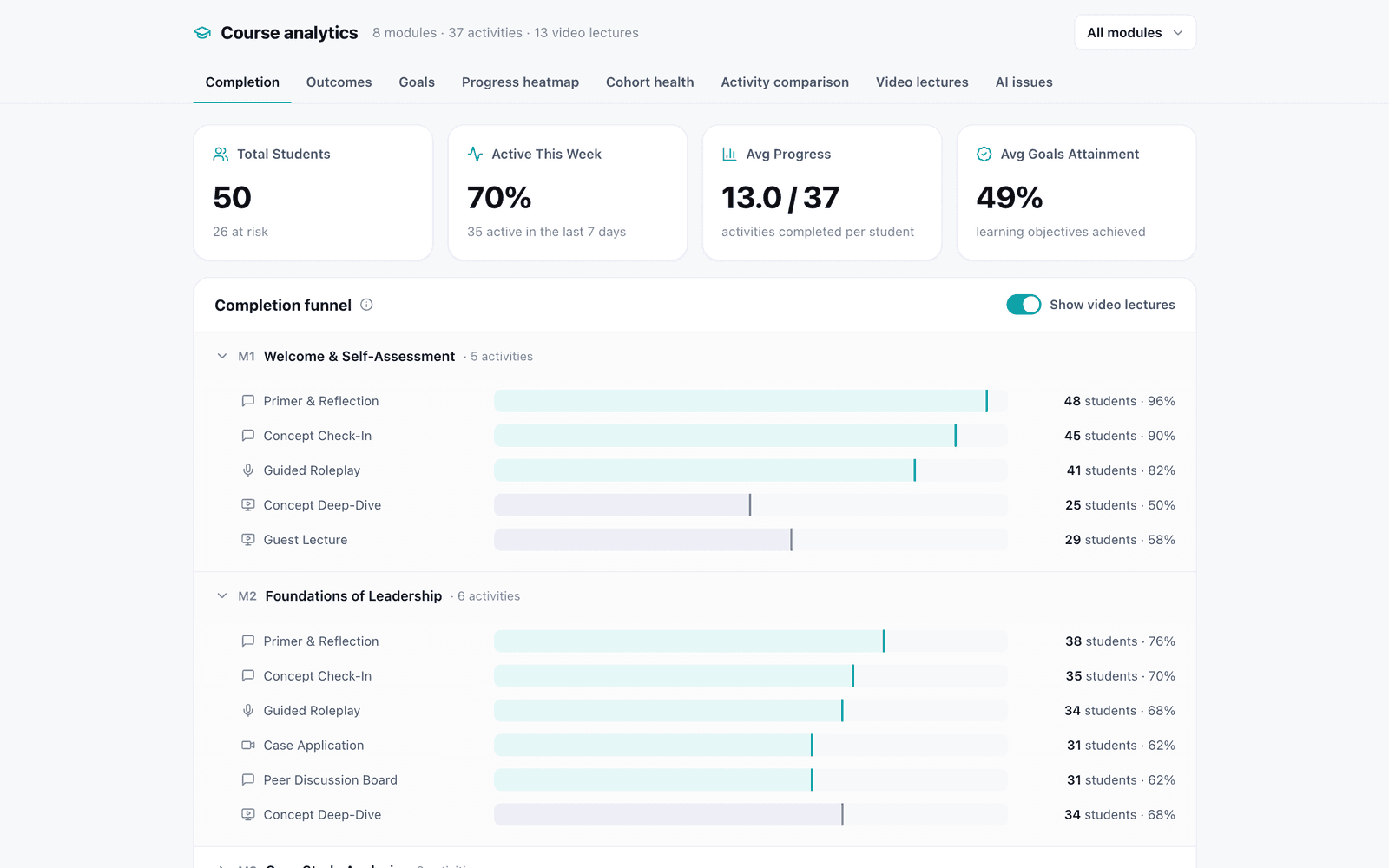
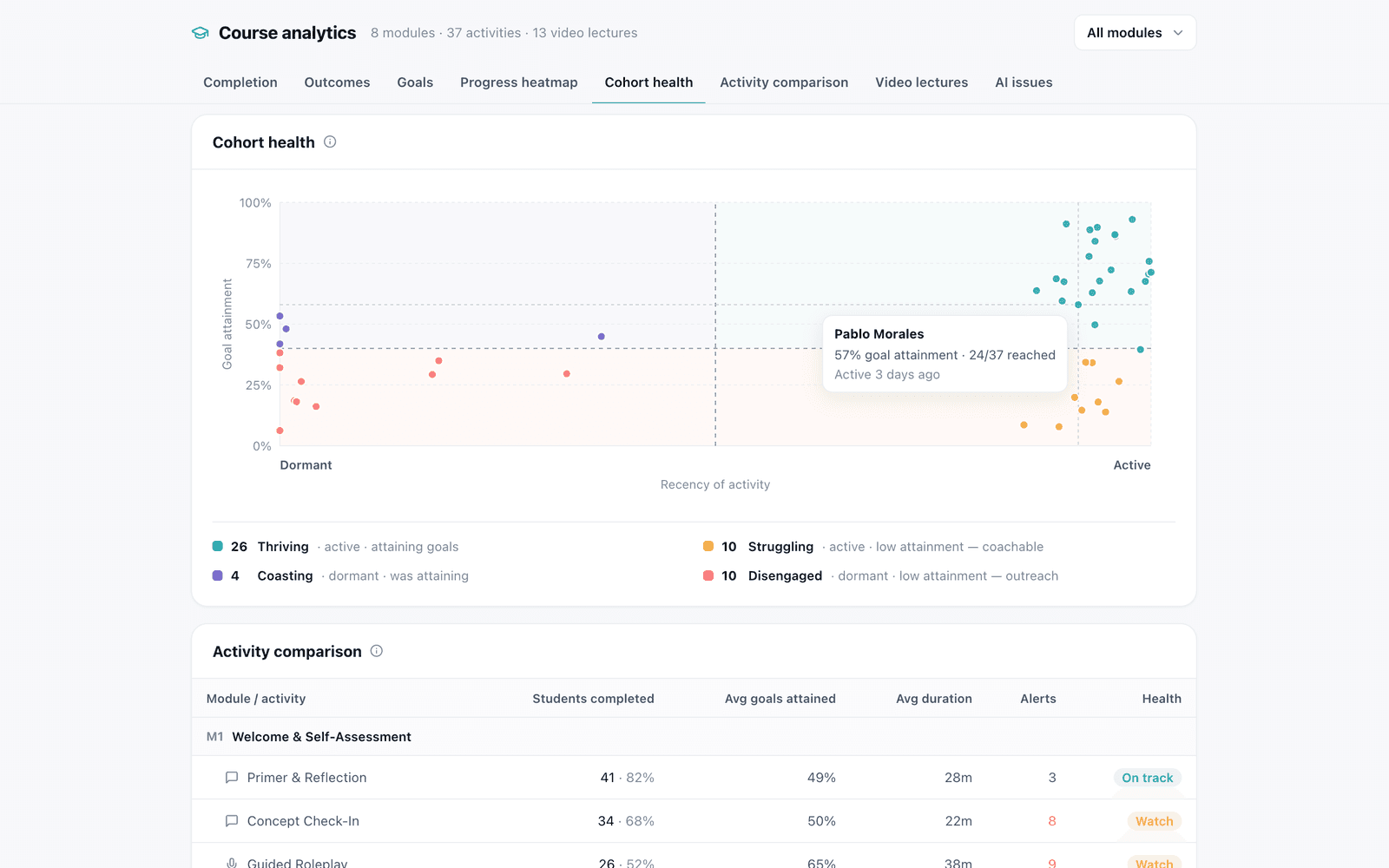
Who is active
This week, by cohort and by student.
Who is at risk
A flagged list, so someone can step in during the term.
Where students stop
The place to look when a course needs revising.
Attainment by objective
How many students have reached each learning objective.
From your material to a live course in weeks.
The 4 steps are discovery, design, build, and deploy. Alma is a service. If you want a tool for making a lesson yourself this afternoon, or an off-the-shelf library, we are the wrong choice.
You approve the design before production starts. The decisions take about a day of your team’s time, and you set how deep the review goes. We build an example from your own material, at no cost, before you decide.
See the full processTell us which course you want built.
Book a demo and bring the course or program you have in mind. A syllabus, a slide deck, or a playbook is enough to start the conversation.