
Written work comes back with comments, and the learner revises and resubmits it.
Alma's learning engineers build each assignment around the kind of work people produce in the field. It is graded against a rubric your faculty or experts approve, and the comments say exactly what to change.
- Graded against
- Your rubric, or one you approve
- Feedback
- Quotes the learner's own words
- Graded by
- AI, your staff, or both
- After feedback
- The learner revises and resubmits
The comments say why points were lost, and what to change.
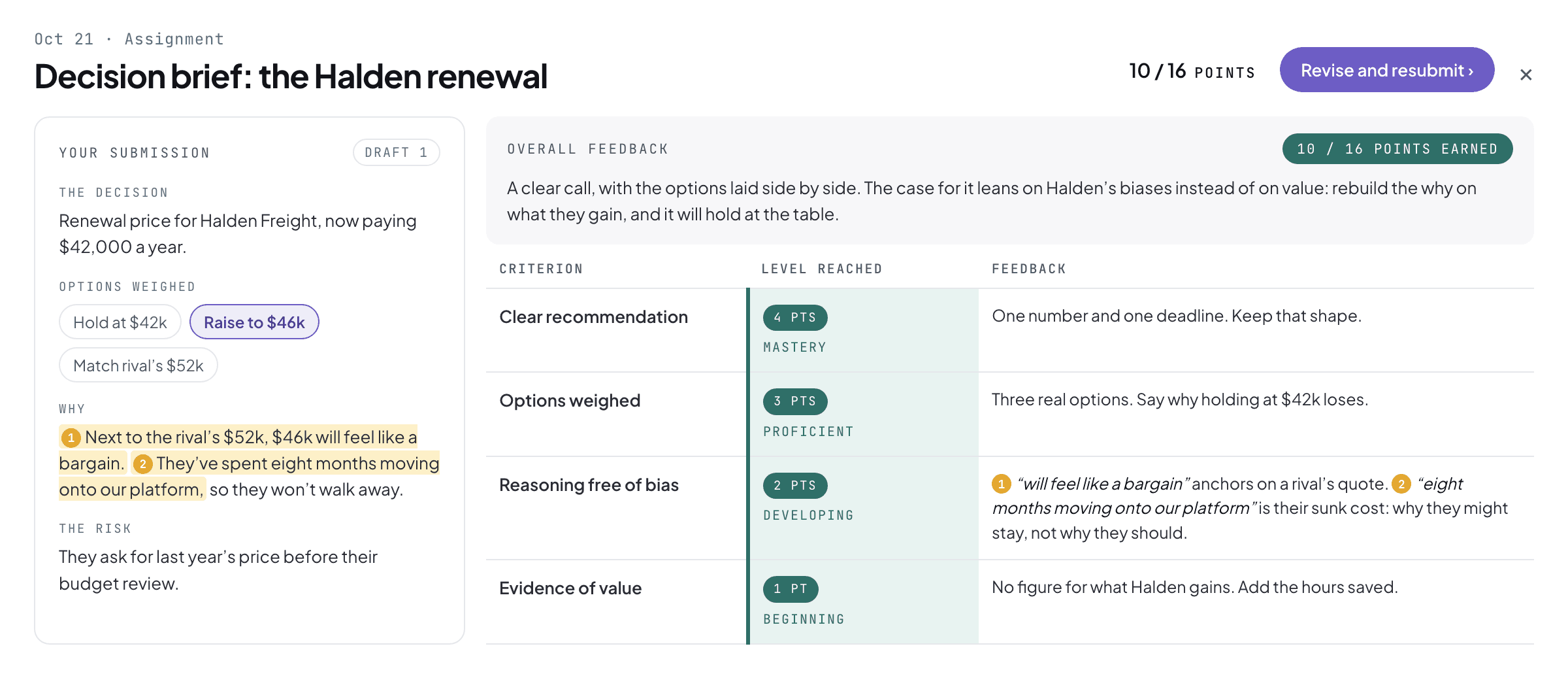
Real work, with a brief and a rubric
Each assignment asks for the kind of thing people produce in the field: a memo, a plan, an analysis. The learner sees what to produce and what it will be graded against, and where you choose, a template to start from.
Comments that quote the work
Each criterion comes back with the level reached and a comment that quotes the learner's own words, so they can see which sentence cost them points and why.
Revise and resubmit
The learner changes the draft in response and hands it in again, and the second draft is graded the same way. The work improves the way it does with a good editor.
Three choices, made for each assignment.
An assignment can start the thinking, or prove it.
It can capture a first answer before anything is taught, ask for a decision on a case, or pull a module together. Three examples, with the assignment in a different place each time.
To see how thinking changes
- Assignment
- Interactive lecture
- Reading
- A revised draft
The learner drafts an answer before anything is taught. The lecture and the reading give them better tools, and the revised draft shows what changed.
To decide on a case
- Case study
- Assignment
- Discussion
- Reflection
The case sets out the situation, and the assignment asks the learner to decide and defend it in writing. The discussion compares answers, and the reflection names what they would change.
To pull a module together
- Interactive lecture
- Practice conversation
- Assignment
- Discussion
After the lecture and the practice conversation, the assignment asks for the real thing on paper: the memo, the plan, the brief. The discussion then compares approaches.
Other work that gets graded.
Knowledge checks & learning games
When a short check with a reason behind every answer is enough, as a quiz or as a game.
See knowledge checksScored simulations
When the work to grade is a live conversation, scored against a rubric.
See scored simulationsStructured discussions
When the written work is a post. Every post gets a considered reply, from the course's AI teaching assistant and from classmates.
See discussionsBook a demo and bring an assignment you already set.
We will show a piece of written work coming back with comments, then talk through the assignments in your course.