
Every post gets a considered reply, and the learner knows who wrote it.
The learner takes a position on a question from the course and defends it. Replies come from an AI in a stated role, named as AI, and from classmates.
- Who replies
- An AI in a stated role, and classmates
- The AI's role
- Teaching assistant or simulation partner
- Built around
- A position to defend
- Grading
- Practice, or graded if you choose
Nobody posts into silence.
Ordinary discussion boards get called busy work: post once, reply to two, and nobody answers. This one is built so that every post is answered.
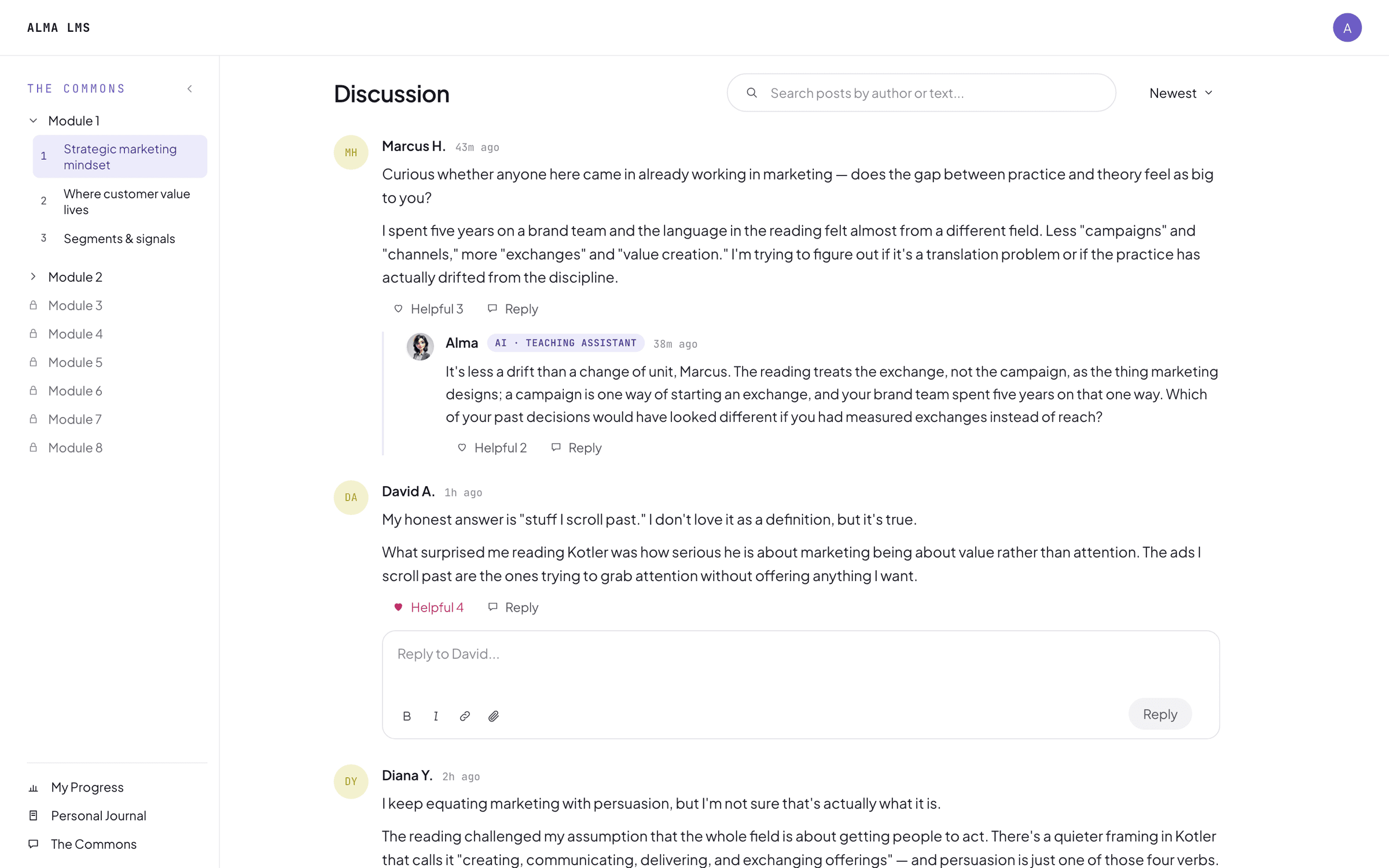
A position to defend
The question comes out of a case, a reading, or a scene in the course. The learner commits to one side and gives reasons, which is harder and more useful than a summary.
Every post is answered
Each post gets a considered reply that answers what the learner wrote, from an AI in a stated role and from classmates. The AI's reply is always labeled as AI.
They answer back
The learner answers the reply, and answers classmates who took a different position. The argument goes a few rounds, the way it would in a seminar room or a team meeting.
Every AI reply is labeled, and your instructor can step into any thread.
An AI in a stated role
The role is shown in the thread: teaching assistant or simulation partner. In either role, the reply is labeled as AI.
Classmates
Other learners reply too, each with a position of their own.
Your instructor or your expert
They can read any thread and reply in it. You decide which roles stay human.
Whether it counts
Whether a discussion counts toward the grade is your decision. Where it does, it is AI-graded and human-confirmed, fully by people, or fully by AI.
A discussion goes wherever there is a question.
It can open a topic, weigh a dilemma, or test positions before the learner has to commit. Three examples, with the discussion in a different place each time.
To open a topic
- Discussion
- Interactive lecture
- Reading
- Reflection
Learners say what they already think before anything is taught. The lecture and the reading then test those first positions, and the reflection asks what changed.
To weigh a dilemma
- Dramatized case
- Discussion
- Reading
- Assignment
The scene raises the question and the discussion argues it. The reading gives the learner the ideas to settle it, and the assignment asks them to.
To test a position first
- Case study
- Reading
- Discussion
- Practice conversation
The case and the reading set out the dilemma, and the discussion tests each position against others. In the practice conversation, the learner has to commit to one out loud.
Where the question comes from.
Reading & case studies
The reading or case that gives a discussion its question.
See reading and casesPractice conversations & simulations
Where the learner commits to a position out loud, against an AI character.
See practice conversationsDramatized cases
A scene that raises the question before the discussion opens.
See dramatized casesBring a question from your course that splits the room.
Book a demo and we will show a discussion built on a question from your course. We build an example from your own material, at no cost, before you decide.