
A one-to-one AI tutor that answers from your own course.
The learner works through the material with an AI tutor, in writing or out loud. It answers from your course, says so when something is not in it, and is named as AI wherever the learner meets it.
- How
- Written or spoken
- When
- Whenever the learner asks
- Answers from
- The course's own material
- Who is speaking
- Named as AI
Help at the moment it is needed.
Most questions come up alone, halfway through a reading or right after a first try, when there is no one to ask. The tutor is there then, and it teaches rather than just answering.
It answers from your course
Answers come from the course's own lectures, readings and cases, not from the open internet. When something is not in the course, it says so instead of guessing.
In writing or out loud
The learner types or talks, one-to-one, in dozens of languages. The tutor is named as AI wherever they meet it, and the instructor can read the conversation.
As a coach, it asks back
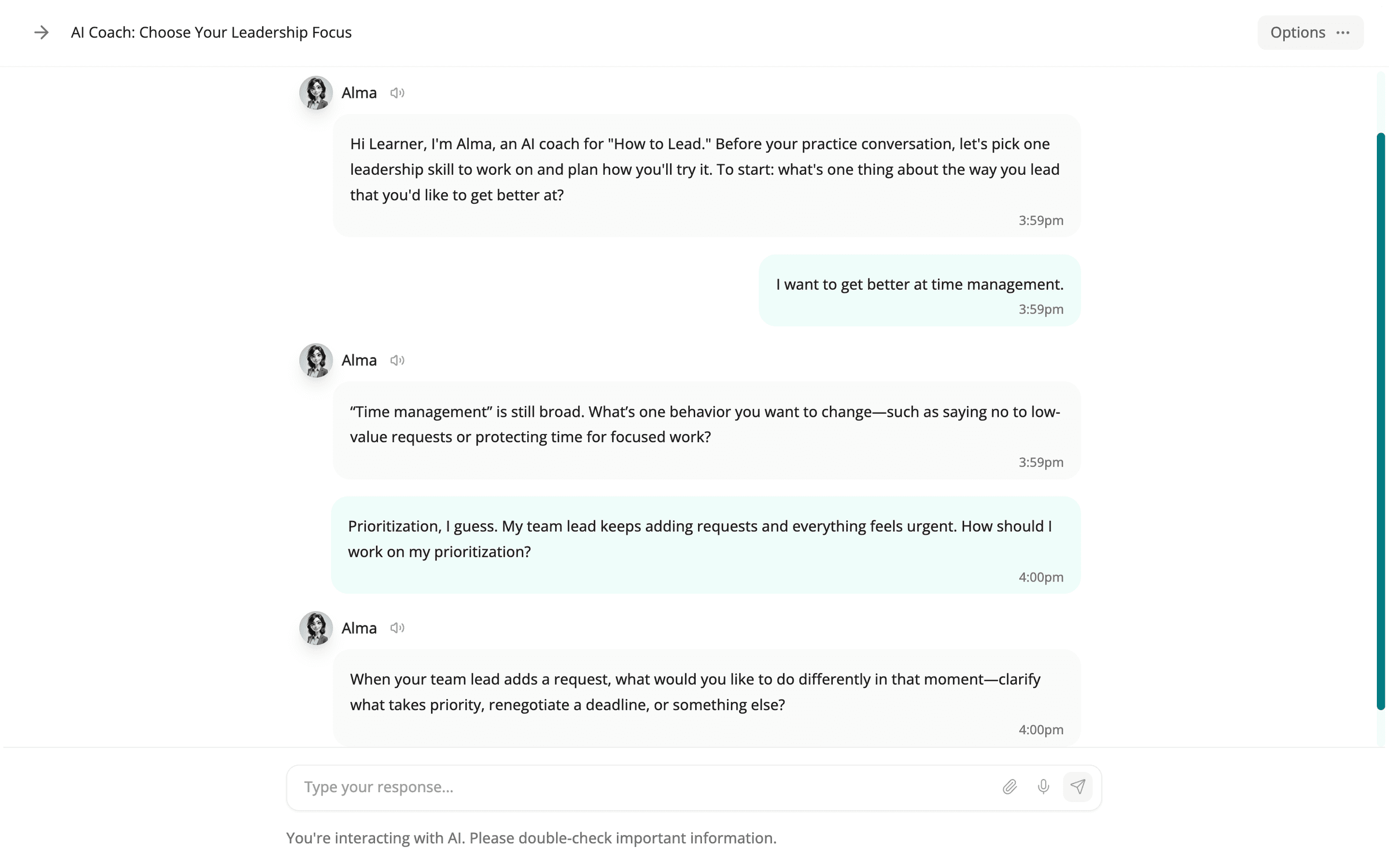
In coaching, the AI coach answers a question with a harder one. A learner who wants to work on time management is told that is still broad, and is asked for one behavior they want to change.
Your instructor or your expert approves what each tutor will and will not do.
The AI tutor supports the teaching of your instructor or your expert, and does not replace it.
Its role and its limits
Each tutor has a written role, a way of questioning, and limits, such as never handing over the answer. Your people approve these before a learner meets it.
Practice or scored
A tutor conversation can be practice only, or scored against criteria the learner can open before starting. Feedback quotes their own words and names what is missing, and grading is your choice: AI-graded and human-confirmed, fully by people, or fully by AI.
The tutor is there at every step.
It can help plan an approach, explain a reading, or go back over a first try. Three examples, with the tutor in a different place each time.
To plan before trying
- AI coaching
- Practice conversation
- Scored simulation
- Reflection
The coach helps the learner work out an approach before the practice conversation, so the first try is a real one. A scored simulation follows, and the learner reflects on what changed.
To understand a reading
- Reading
- AI tutor
- Knowledge check
- Discussion
The learner reads, then works through what they did not follow with the tutor, which answers from that reading. The knowledge check shows what stuck, and the discussion puts it to use.
To learn from a first try
- Case study
- Practice conversation
- AI coaching
- A second conversation
The case sets the situation and the conversation forces a decision. Coaching goes back over the reasoning, and a second conversation tests whether it holds.
More places the learner gets help.
Interactive lectures
When the question comes up in the middle of a lecture.
See interactive lecturesPractice conversations & simulations
When the learner has to hold a position out loud against an AI character.
See practice conversationsReading & case studies
The readings and cases a tutor answers from.
See reading and casesSee a tutor answer from material like yours.
Book a demo and bring a reading or a case from the course you have in mind. We build an example from your own material, at no cost, before you decide.