
The dashboard says complete. Alma shows who is ready.
In a program Alma builds, each person is measured against the standard your experts set, from what they said and did. You see who is ready, per person and per team.
Sales onboarding
Class of 12
- Ready
- Another go
- Ready
- Stuck
- Ready
- What you see
- Who is ready
- Measured against
- The standard your experts set
- Based on
- What people said and did
- Read beside
- A number the business tracks
A completion rate records that someone reached the last screen.
What a completion rate records
That someone reached the last screen.
What it cannot tell you
- Whether they can handle a price objection
- Whether they can give a hard piece of feedback
So when the business asks what the training changed, the only report on hand is who finished. In a program Alma builds, every practice conversation and every check is measured against what good looks like in your business, so there is more to report.
You see who is ready, who is stuck, and the evidence behind each result.
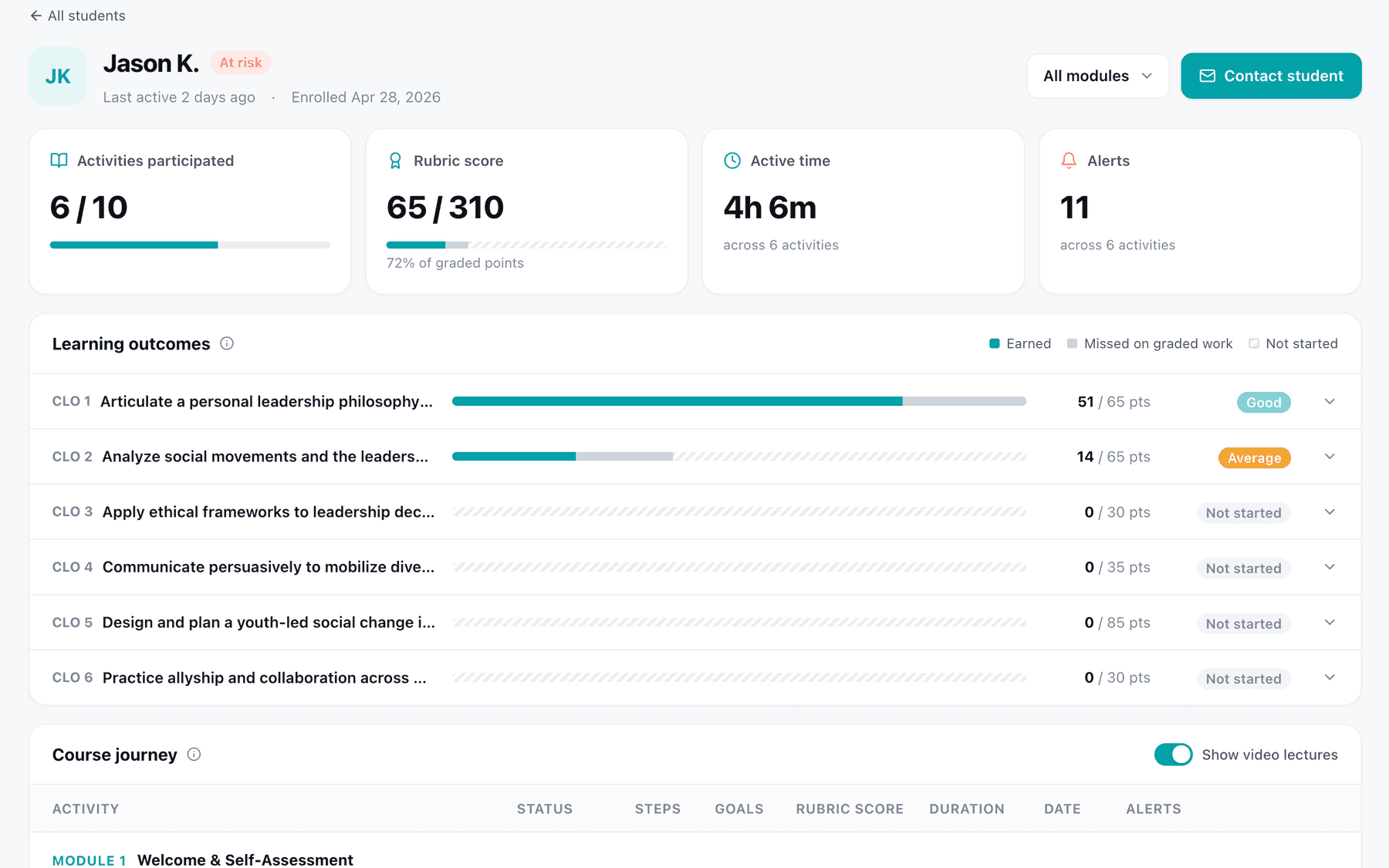
Who is ready, per person
For each skill in the program, whether the person has met the standard your experts set.
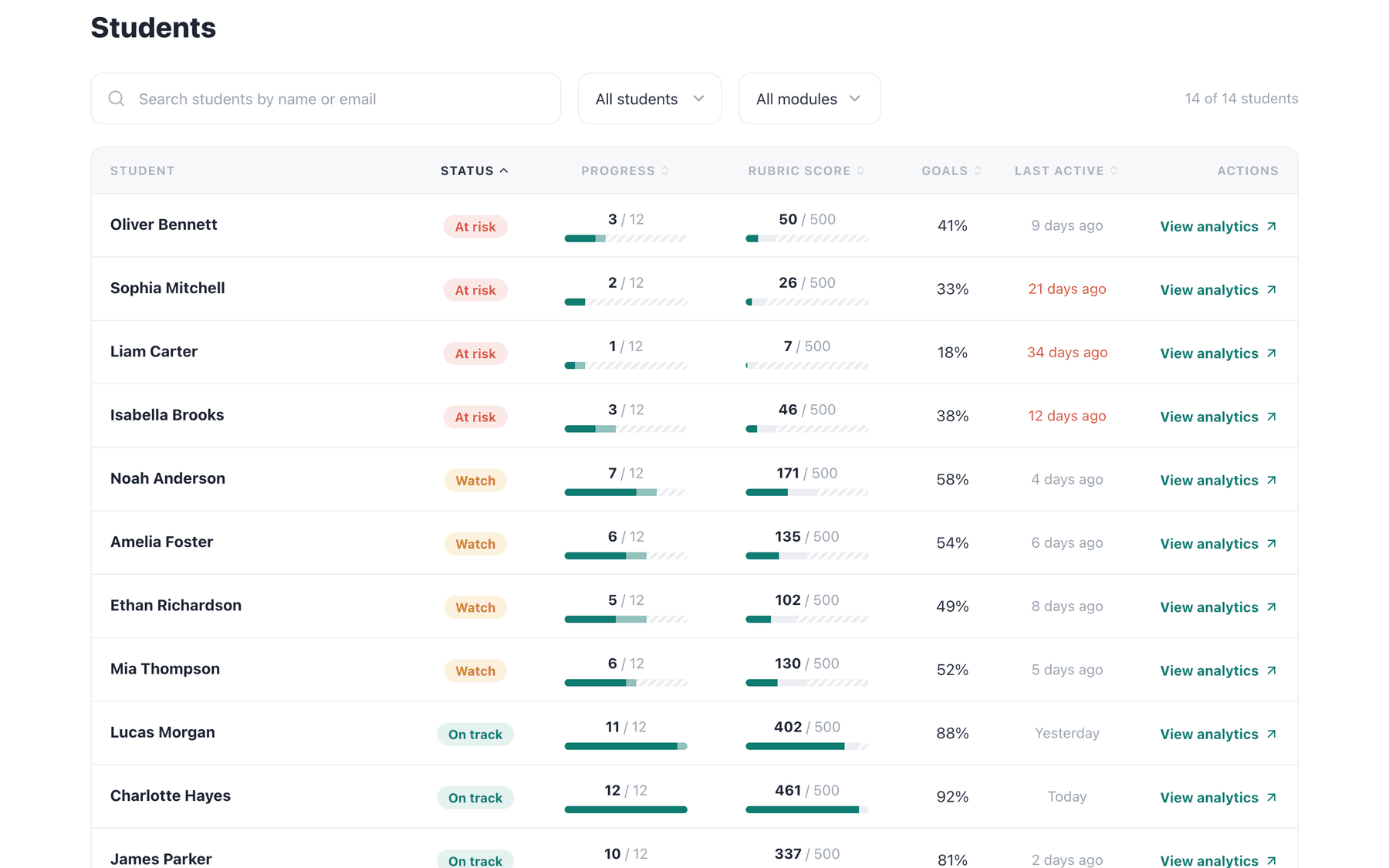
Who is ready, per team
The same for a team or a whole class of new hires, so you can see where the group stands.
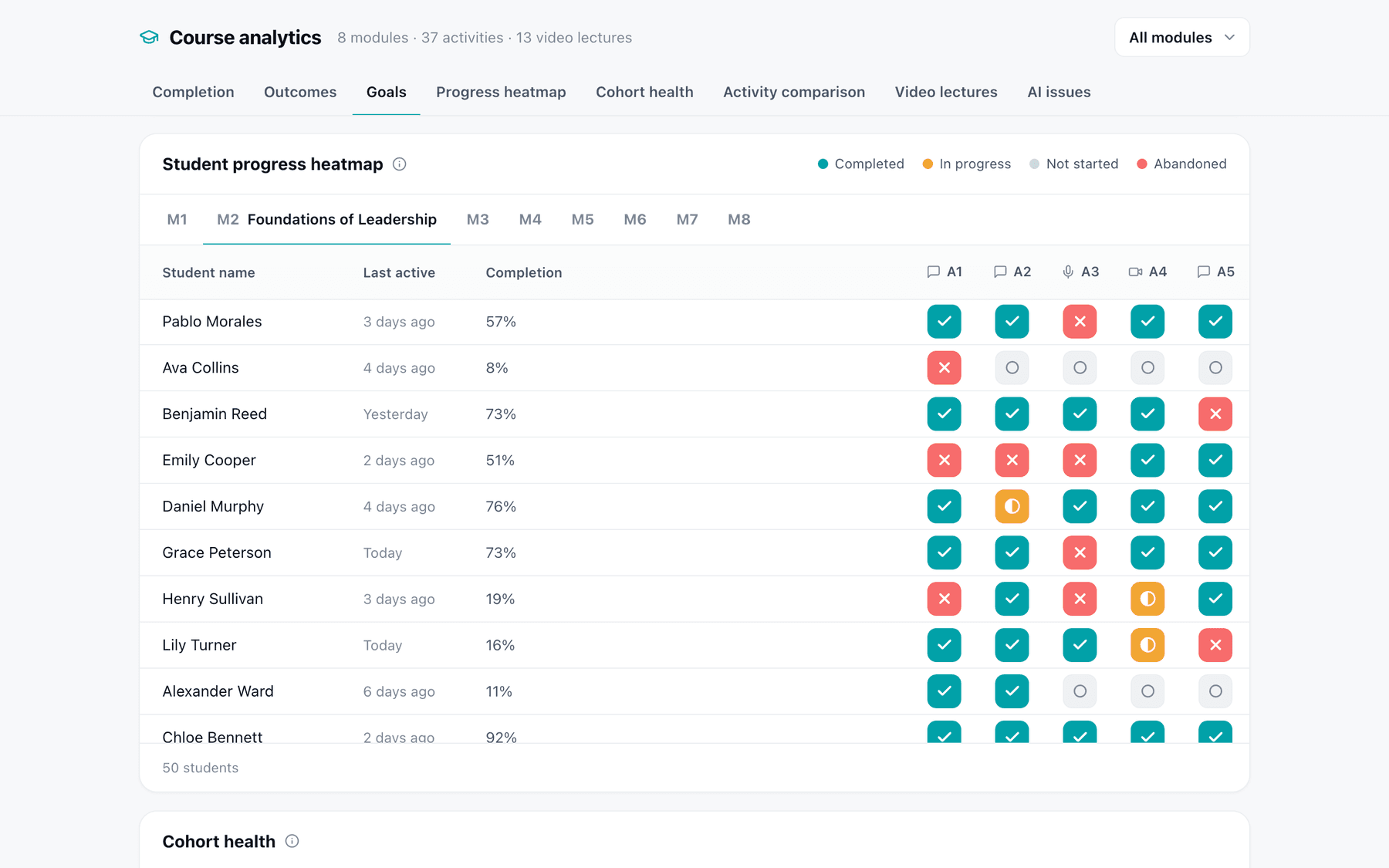
Who is stuck, and where
Which people have stopped, and at which part of the program.
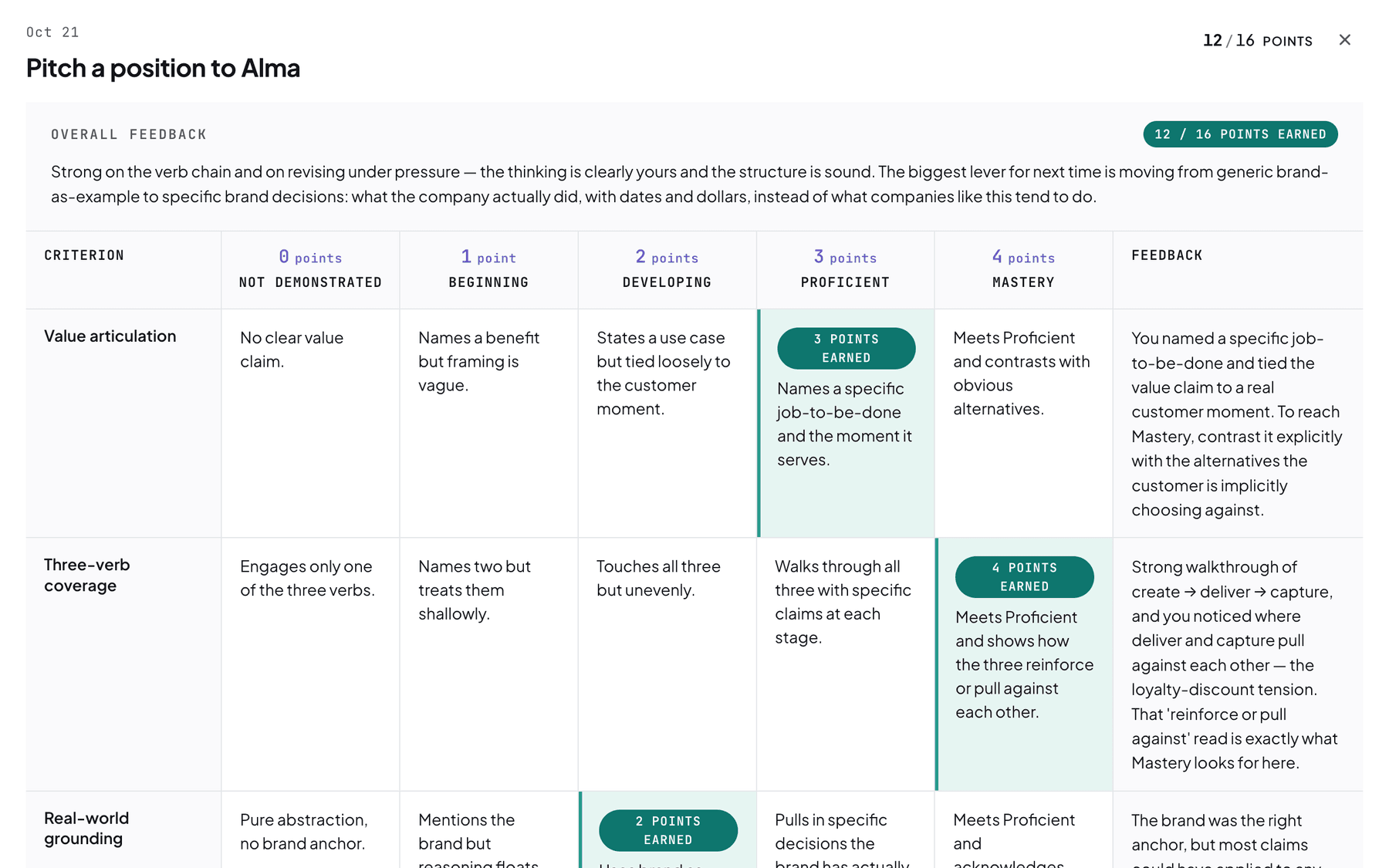
The evidence behind each result
Each result opens into the standard: the level reached on each skill, and feedback on what was missing and what would reach the next level. You can open a person’s progress and read it. What people say stays on Alma’s platform and is never used to train a model; only your own staff and the few Alma people building your program can see it.
Readiness is set beside a number the business already tracks.
Alma does not prove business impact. It shows who is ready inside the program, with the evidence. Ramp time or escalations are measured by your business, in your own reporting, and other things move that number too. Before the program is built, we agree on one group, such as new managers or one sales team, and one number you already report.
Your experts set the standard before anything is built.
Your experts say what good looks like
They define it for each skill, in your terms, or approve a draft we write from your material.
People are measured on what they said and did
The check is a conversation or a piece of real work, so nobody passes by guessing.
You choose who confirms a result
A result can be scored by AI and confirmed by a person, fully by people, or fully by AI.
The measure is designed with the program, not as a separate project.
The decisions take about a day of your experts’ time. Readiness comes from the practice and the checks designed into a program, so it does not report on training Alma did not build: for a program you already run, the route is a rebuild. See the full process →
Step 1
Agree the standard and the number
Alma's learning engineers
At the start we ask what your people currently do wrong and which number the business tracks, and draft what good looks like for each skill.
Your people
Before the build
Your experts approve what good looks like, and you pick one group and one number you already report.
Step 2
People practice and are checked
Alma's learning engineers
Every practice conversation and every check is measured against that standard, and the views fill in as people work.
Your people
During the program
Your managers see who is ready and who is stuck, while there is time to help.
Step 3
Read it beside the number
Alma's learning engineers
We show who the program showed as ready, with the evidence behind each result.
Your people
After the program
You set it beside the number from your own reporting, and draw the conclusion. Review is separate, and you set how deep it goes.
What you could see after a class of new hires finishes sales onboarding.
In the program
Each new hire handles a price objection out loud
An AI counterpart plays the buyer. The conversation is measured against the standard your sales leaders set.
Per person
You see who has met it and who needs another go
For those who need one, the feedback quotes the sentence where they gave ground and names one thing to change next time.
Per team
You see where the class is stuck
If several new hires are stuck on the same skill, that shows before any of them takes a real call.
Beside the business number
Ramp time is read against readiness
Ramp time comes from your own reporting. You compare it with who the program showed as ready, and you draw the conclusion.
Programs that show who is ready.
Custom training programs
When you have the material and need the program.
See custom programsModernizing existing training
When the program exists and reports only who finished.
See modernizing trainingPractice around instructor-led training
When a facilitator runs the sessions and you want practice around them.
See instructor-led trainingPrograms we build
Every kind of corporate program on one page.
See all programsBring one program and one number the business tracks.
Tell us what you report today and what the business asks you for. We will show you what a program reports and say whether it fits.