Many educators already know the Brown University story.
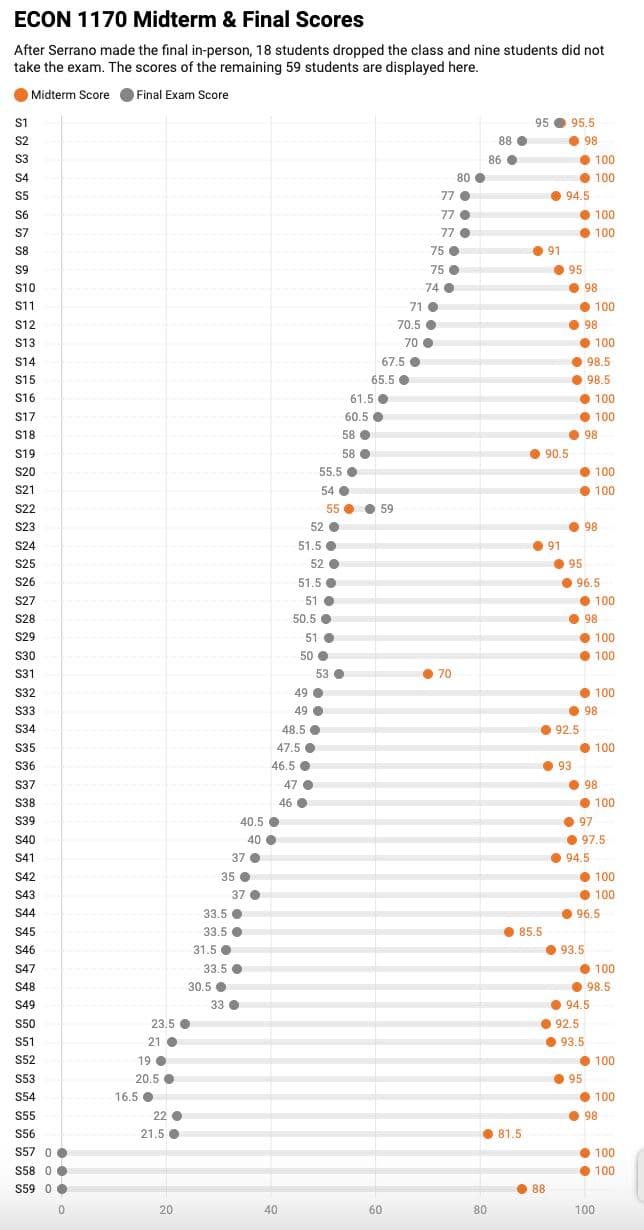
An economics professor replaced a usual in-class midterm with a take-home (but still closed-book) exam for the first time in 20+ years of teaching. Because students had more time to work, he intentionally made the assignment more difficult than he normally would. The result was striking: the vast majority of students aced the midterm, yet those same students performed dramatically worse on the in-class final.
- Many students likely violated the rules of the take-home exam.
- GenAI appears to have been one of the tools many of those students used.
To me, it’s the public attention, not the pedagogy, that makes this story interesting.
It reminds me of Raiders of the Lost Ark. Fans of The Big Bang Theory will remember an observation: if Indiana Jones had never existed, the movie would have ended exactly the same way. The Nazis would still have found the Ark, taken it to the island, opened it, and died. Just like they did in the movie.
Now imagine the Brown story taking place in the fall of 2022, just before ChatGPT became publicly available. Same professor. Same students. Same take-home, closed-book midterm. No GenAI.
What changes?
- Students suddenly decide to follow the rules?
- They still cheat, but achieve somewhat lower scores?
- The instructor doesn’t notice anything unusual?
- Something else?
My guess is B. AI probably made cheating easier. The score distribution might not have been quite as dramatic, but I suspect the educational lesson would have been much the same.
Which brings me to another old joke.
A journalist asks the Pope, “Your Holiness, have you ever visited any of the prostitutes in Paris?” The Pope pauses and replies, “Are there prostitutes in Paris?” The next morning’s headline reads: “Pope’s first question upon arriving in Paris: ‘Are there prostitutes in Paris?’”
That’s a bit how AI feels in this story. It makes for a much more provocative headline than “Brown students cheated on a take-home exam.”
Before AI there was plagiarism. Before widespread internet access there were books full of “sample essays.”
- There were students writing papers for one another.
- Students taking exams for classmates.
- Hidden notes.
- Hidden radios.
- Bluetooth earpieces.
- Machine translation used to disguise copied text.
- Smart glasses.
Every generation has its own technology. The underlying incentive hasn’t changed. Students cheat when they see more value in passing than in doing the work. They choose whatever strategy best balances effort, reward, and the risk of being caught.
Perhaps the most interesting question raised by the Brown story isn’t “How do we stop students from using AI?” It’s “Why do so many students conclude that cheating is the rational strategy in the first place?”
That, to me, is a far more interesting conversation than whether the latest cheating tool happened to be ChatGPT.